

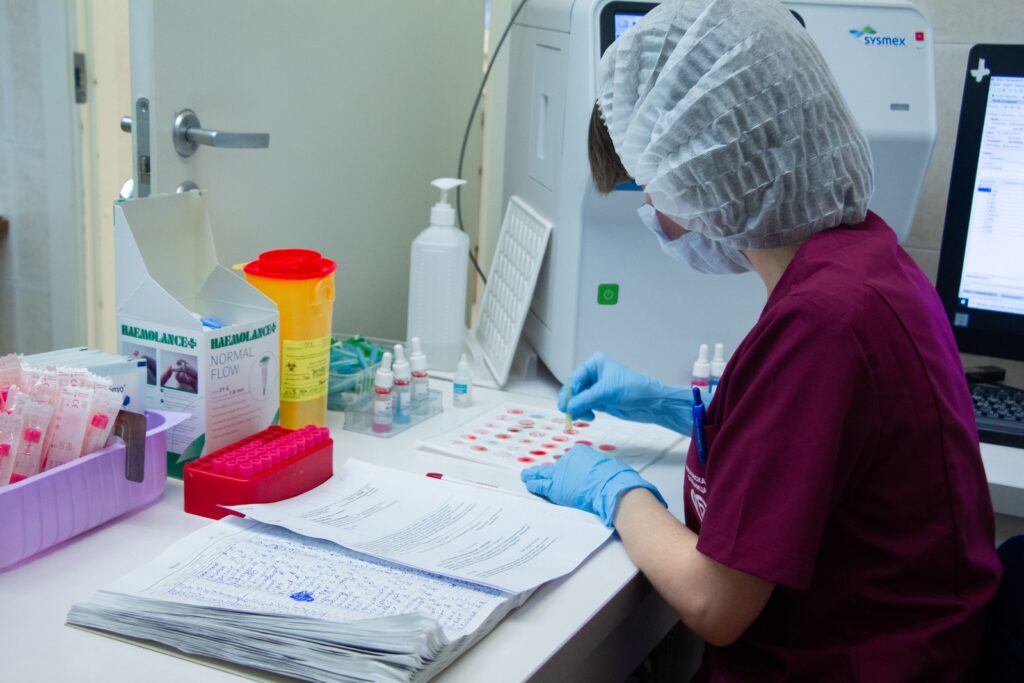
An AMH test in Kenya is a simple blood test that estimates how many eggs you have left. Many women search for it after a doctor mentions “ovarian reserve”. Others look it up because they plan to freeze eggs or start IVF. Then the result arrives, and the numbers can feel confusing. This guide explains what AMH is and what normal levels look like by age. It also covers what the test costs in Nairobi and what it cannot tell you. We last checked it on 16 November 2026.
At a glance
- AMH (anti-Müllerian hormone) reflects the number of small follicles in your ovaries. It estimates egg quantity, but not egg quality.
- Levels fall with age. For example, Cleveland Clinic lists general estimates of about 3.0 ng/mL at 25 and about 1.0 ng/mL at 40.
- Four Kenyan laboratories we checked list the test at KSh 5,900 to KSh 8,000, so prices vary.
- Guidelines also advise against using AMH to predict whether you will conceive naturally.
In this guide
What is an AMH test?
AMH is a hormone made by cells around the small, growing follicles in the ovaries. Each follicle holds an egg. Because of this, the more small follicles you have, the more AMH enters your blood. An AMH test measures that level in a blood sample from a vein in your arm.
Doctors often call the result a marker of ovarian reserve. That means the remaining supply of eggs. The test also needs no special preparation. According to Cleveland Clinic, you can have it on any day of your cycle. This is because AMH does not change much from week to week.
Why doctors order an AMH test in Kenya
An AMH test is usually part of a wider fertility assessment. Common reasons include:
- Planning IVF. AMH helps predict how your ovaries may respond to stimulation medicine. The 2026 NICE guideline advises using AMH or an antral follicle count to predict ovarian response. It also advises using the result to counsel people about their chance of a live birth after assisted conception.
- Choosing a medicine dose. The ESHRE ovarian stimulation guideline (2019) strongly recommends using either AMH or antral follicle count, rather than other ovarian reserve tests, to predict a high or a poor response to stimulation.
- Thinking about egg freezing. The result also helps your doctor estimate how many eggs a cycle may collect. Read our guide to egg freezing in Kenya for more.
- Checking after treatment or surgery. It can also show whether surgery or cancer treatment has affected the ovaries.
- Looking for conditions such as PCOS. AMH may be high in some women with polycystic ovary syndrome.
At Hope IVF Clinic, our female infertility treatment service lists AMH and FSH testing among its assessments. Your doctor then reads the result together with your age, history and an ultrasound.
What an AMH test cannot tell you
This is the part most online articles skip. An AMH result is useful, but it is not a verdict on your fertility.
- It does not predict natural pregnancy. NICE guideline NG257 (31 March 2026) says not to use AMH as a predictor of pregnancy through spontaneous conception. Instead, it advises using age as the first guide.
- It shows quantity, not quality. Therefore, the result says little about how healthy the eggs are.
- It is not a deadline. A study in JAMA in 2017 followed 750 women aged 30 to 44 with no history of infertility. However, women with low AMH (below 0.7 ng/mL) did not conceive at a significantly different rate over 6 or 12 cycles of trying than women with normal values.
- Doctors cannot read it alone. Likewise, the American Society for Reproductive Medicine says that ovarian reserve markers are “poor predictors of reproductive potential independently from age”. See its 2020 committee opinion.
So an AMH test in Kenya, or anywhere else, answers one narrow question: how many eggs might a stimulated cycle collect? It does not, however, answer whether you can have a baby.
AMH levels by age: what is normal?
AMH rises through the teens, peaks at around 25, and then falls with age. Experts debate how to define a normal AMH level, and labs also use different equipment. Because of this, always compare your result with the reference range printed on your own report. In addition, one review of assay differences, published in Reproductive BioMedicine Online, explains why raw values from different methods can differ substantially.
Cleveland Clinic gives these general estimates, but they sit at the lower end of the typical range for each age:
| Age | General estimate (ng/mL) |
|---|---|
| 25 | about 3.0 |
| 30 | about 2.5 |
| 35 | about 1.5 |
| 40 | about 1.0 |
| 45 | about 0.5 |
The same source describes an average AMH level as 1.0 to 3.0 ng/mL and a low level as under 1.0 ng/mL. It describes a severely low level as about 0.4 ng/mL. However, these are broad bands, and they are not cut-offs for diagnosis.
Check the unit. Many labs report ng/mL, but some reports use pmol/L. To convert, multiply ng/mL by about 7.14, as explained in this unit converter. For example, 1.0 ng/mL is about 7.1 pmol/L.
What Kenyan data show
Most charts come from Europe and North America. There is, however, one large Kenyan study. Researchers at Aga Khan University Hospital, Nairobi, analysed AMH results from 1,678 women aged 15 to 49 whom the hospital tested between 2015 and 2019. The paper appeared in the South African Journal of Obstetrics and Gynaecology in December 2022.
- Overall, the median AMH was 0.87 ng/mL.
- AMH fell by about 0.18 ng/mL for every extra year of age.
- About 14.9% of women aged 20 to 24 fell below 1.1 ng/mL, a cut-off for diminished ovarian reserve. The share then rose to 48.7% at ages 35 to 39 and 96.5% at ages 45 to 49.
Please read these numbers with care. The women were hospital patients, not a random sample, and many came because of fertility concerns. Their median age was 38, and only about 3% were under 25. Age also explained only about 21% of the variation in AMH. The authors warned that the results may not apply to women without fertility concerns. They also noted that other studies link AMH to factors such as body mass index and ethnicity. Therefore, they called for more local research.
The practical message is simple. A result below an international chart does not automatically mean that something is wrong. Equally, a low result is worth discussing early, rather than waiting.
How to read your AMH result
Your doctor will read your AMH test in Kenya result alongside your age, your cycle and an ultrasound count of antral follicles. As a rough guide:
- Low AMH. This suggests fewer remaining eggs than average for your age. The Kenyan study paper, citing earlier work, notes that levels below about 1.1 ng/mL predict a poor response to ovarian stimulation. As a result, your doctor may plan a different medicine dose, or discuss treatment sooner.
- Typical AMH. This is reassuring for the egg supply, but it does not guarantee a pregnancy.
- High AMH. This can occur with PCOS. Also, the same paper notes that levels above about 4.8 ng/mL predict ovarian hyperstimulation syndrome (OHSS) during IVF. Therefore, your doctor can adjust treatment to reduce that risk.
AMH test cost in Kenya
The cost of an AMH test in Kenya depends on where you go. We checked the public prices of four Kenyan laboratories on 16 November 2026. Prices change, so confirm before you book.
| Laboratory | Listed price | Source (checked 16 Nov 2026) |
|---|---|---|
| Labtest Zote Diagnostics, Hurlingham, Nairobi | KSh 5,900 | Test page |
| DNA Labs Kenya | KSh 6,000 | Catalogue |
| Biopassion Diagnostics, Gachie, Nairobi | KSh 6,960 (regular price KSh 8,000) | Test page |
| Nutri Health Solutions, Westlands, Nairobi | KSh 8,000 | Price list |
That is a range of about KSh 5,900 to KSh 8,000 for the blood test alone. However, a fertility clinic may price the test differently. For example, it may be part of a panel with FSH, LH and estradiol, or come together with a scan and consultation. Also, we did not find published AMH prices on the Nairobi IVF Centre or Footsteps to Fertility pages we reviewed.
These figures are third-party laboratory prices, not Hope IVF Clinic prices. Because we do not publish clinic prices online, we will not guess them. Contact us for a quote for an AMH test as part of your assessment.
How to get an AMH test in Kenya
You can get an AMH test in Kenya in three main ways. Each route, however, has trade-offs.
- Through a fertility clinic. You usually see a doctor first. Then the doctor explains the result together with an ultrasound. This is the most useful route if you are planning treatment.
- Through your own doctor or hospital. Some hospitals, such as Aga Khan University Hospital, Nairobi, also run AMH tests in their laboratories.
- Directly from a private laboratory. This is usually the cheapest option. However, you will then need someone to interpret the number for you.
You do not need to fast. Results from a laboratory can take a few days. However, DNA Labs Kenya lists same-day reports for samples collected by 4 pm. Home finger-prick kits exist, but Cleveland Clinic advises seeing a specialist to interpret the result.
What to do if your AMH is low
First, do not panic. After an AMH test in Kenya, a single number is only one piece of information. Then, take these steps in order:
- Repeat or confirm. Different labs use different methods, so ask whether a repeat test, or an ultrasound antral follicle count, would help.
- Look at your age and goals. If you want a baby soon, a low result is therefore a reason to see a specialist earlier.
- Discuss your options. Depending on your situation, these may include timed intercourse with follicular monitoring, IUI or IVF. You could also freeze your eggs with cryopreservation.
- Be careful with products. AMH reflects follicles that already exist. We did not find any guideline or review recommending a supplement to raise AMH itself, and the ASRM opinion cited above does not discuss supplements. The Cochrane review of DHEA and testosterone before IVF covers evidence to January 2024. It found that DHEA likely has little to no effect on the chance of pregnancy in poor responders, although testosterone probably helps. ESHRE’s 2019 guideline did not recommend either for improving the efficacy or safety of stimulation. However, those studies measured pregnancy outcomes, not AMH, so speak to your doctor before spending money.
Not sure what your result means? We will listen first, in private. Make an appointment through our contact page, or call us on +254 116 095891. Hope IVF Clinic is on the 8th Floor, PMC, 3rd Parklands Ave, Nairobi. We are open Monday to Friday, 8am to 7pm.
When should you see a fertility specialist?
Do not wait for an AMH test to decide. As reported by The Star on 10 November 2026, Dr Charles Muteshi, head of fertility services at Aga Khan University Hospital, gives two timelines. Women younger than 35 should seek assessment after a year without pregnancy. However, women older than 35 should seek it after six months. Our guide to age and fertility covers this in more detail.
Frequently asked questions about the AMH test in Kenya
What is a normal AMH level?
It depends on your age and your lab. Cleveland Clinic describes 1.0 to 3.0 ng/mL as average and under 1.0 ng/mL as low. However, a large Kenyan hospital study found a median of 0.87 ng/mL, although many of the women had come with fertility concerns. So always compare your number with your own lab’s reference range.
How much does an AMH test in Kenya cost?
Four Kenyan laboratories listed prices from KSh 5,900 to KSh 8,000 on 16 November 2026. However, fertility clinics may charge differently. Contact us for a quote for an assessment at Hope IVF Clinic.
Can I get pregnant naturally with a low AMH?
Often yes, as long as you have no other fertility problem. A 2017 JAMA study of women aged 30 to 44 with no history of infertility found no significant difference in conception rates between women with low and normal AMH. NICE also advises against using AMH to predict spontaneous pregnancy. Age and overall health matter more, so speak to a doctor.
Is AMH 1.0 low?
Cleveland Clinic places average levels at 1.0 to 3.0 ng/mL, and calls levels under 1.0 low. Therefore, a result of 1.0 sits at the edge. For a 40-year-old it is within the general estimate, while for a 28-year-old it may be lower than expected. Your doctor will interpret it for your age.
Do I need to fast or pick a cycle day for an AMH test in Kenya?
No. You can have the test on any day of the cycle, and you need no preparation. However, labs usually test other hormones, such as FSH, early in the cycle, so ask your doctor which tests they plan.
Can I raise my AMH?
None of the guidelines cited in this article recommends a way to raise AMH, which reflects follicles that already exist. Still, good general health is worthwhile. However, be wary of products that promise to boost AMH. Discuss any supplement with your doctor.
Does a high AMH mean PCOS?
Not always. AMH can be high in some women with PCOS, as Cleveland Clinic notes. However, doctors diagnose PCOS using symptoms, hormone tests and ultrasound together. A high result is one reason to look further, not a diagnosis.
Is an AMH test in Kenya enough to check my fertility?
No. A full assessment also looks at ovulation, the fallopian tubes, the womb and your partner’s semen analysis. Our male infertility service covers the partner’s side.
Your next step
If you are planning an AMH test in Kenya, or you already have a result and want it explained, book a private conversation. Make an appointment through our contact page, or call us on +254 116 095891. Hope IVF Clinic is open Monday to Friday, 8am to 7pm, at 8th Floor, PMC, 3rd Parklands Ave, Nairobi.
We compiled the medical information on this page from the sources linked above and last checked it on 16 November 2026. It does not replace advice from your own doctor. Laboratory prices come from third-party websites and are not Hope IVF Clinic prices.
Featured image: “Human Blood Test” by Ja muzalevskaya, via Wikimedia Commons, released under CC0. Resized.