

Egg freezing in Kenya is no longer a rare topic. More women in Nairobi now ask whether they can pause the biological clock. They also ask what it would cost. This guide answers both questions, using published figures, named sources and plain language. We last checked it on 16 November 2026.
It is general information only. A fertility doctor will advise on your own case, but no article can tell you how many eggs you would collect. Nor can it say whether they would lead to a baby.
In this guide
What is egg freezing?
Egg freezing, also called oocyte cryopreservation, means collecting a woman’s eggs, freezing them and storing them for later. Eventually, when she is ready, the laboratory thaws the eggs and fertilises them. Then the doctor places any resulting embryo in the womb.
People consider it for a simple reason: egg numbers and quality fall with age, so eggs frozen earlier keep the age they had at collection. The UK regulator, the HFEA, describes it as becoming more successful but “by no means a guarantee of having a baby”.
Modern freezing uses vitrification, a very fast method that turns the egg into a glass-like state. According to the HFEA, vitrification has proved to work better than the older slow-cooling method. Likewise, our cryopreservation service in Nairobi describes this approach, with storage in liquid nitrogen tanks.
Who might consider egg freezing in Kenya?
There are two broad groups. Some people are not ready to have a baby yet, while others have treatment or health problems that may reduce their fertility.
- Planned freezing. This suits women who want more time, for example to finish studies, build a career or find the right partner. The American Society for Reproductive Medicine (ASRM) calls this “planned oocyte cryopreservation” and says it is ethically permissible, as long as clinics tell people about the uncertainties.
- Medical reasons. Chemotherapy, radiotherapy or surgery on the ovaries can harm fertility. The ESHRE female fertility preservation guideline covers these situations. So ask about freezing before treatment starts, ideally right after your diagnosis.
- Risk of early menopause. Some women have a family history or a condition that may shorten their reproductive years. Because of this, a specialist can review the risk with you.
Egg freezing in Kenya is still a small but growing service, and newer centres are also entering the field. For example, The Star reported on 10 November 2026 that Aga Khan University Hospital has opened a one-stop fertility centre in Westlands. It offers egg, sperm and embryo freezing. In a 2023 interview with the Daily Nation, Dr Sarita Sukhija of Myra IVF Centre named her typical clients. They were women aged 35 to 37 without a partner, women in long-distance marriages and cancer patients. However, she also said egg freezing was “still not very popular in Kenya”.
The egg freezing process, step by step
The steps of egg freezing in Kenya are the same as the first half of an IVF cycle. The HFEA also notes that this part usually takes around two to three weeks. Here is what normally happens.
- Consultation and tests. Your doctor reviews your history and may arrange an AMH blood test and an ultrasound to count antral follicles. Together, these estimate your ovarian reserve. Screening for HIV and hepatitis is also standard, so that the clinic can store samples safely.
- Ovarian stimulation. You inject hormones for about 10 to 14 days. As a result, several eggs mature at once, instead of the single egg of a natural cycle.
- Monitoring. Scans, and occasionally blood tests, track how the follicles grow. This is where follicular monitoring helps your doctor adjust the dose and choose the day for the trigger injection.
- Egg collection. Then the doctor collects the eggs through the vagina under ultrasound guidance, with sedation or anaesthesia. The procedure itself is short.
- Vitrification and storage. Soon after collection, the laboratory freezes the mature eggs and stores them in liquid nitrogen at about −196 °C.
One patient in the Daily Nation said she was back to her normal routine soon after collection. The HFEA also says side effects from the fertility drugs are usually mild. Your clinic should still explain which symptoms need a phone call.
Thinking about freezing your eggs? Talk to a doctor first, in private. Make an appointment through our contact page, or call us on +254 116 095891. Hope IVF Clinic is on the 8th Floor, PMC, 3rd Parklands Ave, Nairobi. We are open Monday to Friday, 8am to 7pm.
What age to freeze eggs
Younger is better for egg freezing in Kenya or anywhere else, but there is no single cut-off. In its 2021 evidence-based guideline, the ASRM concluded that younger age appears to give higher ongoing pregnancy and live birth rates, on limited data. However, it also said there is not enough evidence to predict live birth rates after planned freezing.
Two numbers help to set expectations. First, the ASRM ethics opinion says that a woman at 38 needs roughly 25 to 30 frozen eggs for a reasonable chance of one child. Second, a single US clinic series by Doyle and colleagues (2016) found that about 6 in every 100 vitrified-warmed eggs led to a live-born child overall. The women froze eggs for several reasons, and the authors also gave estimates by age at retrieval.
Closer to home, Dr Sukhija told the Daily Nation that up to about 37 is “okay”. She added that older women may need two or three cycles to collect enough eggs. Treat this as one specialist’s view, because your own AMH level, antral follicle count and age matter more than any general rule. Our article on age and fertility explains the wider picture.
How many eggs are enough?
There is no magic number. The HFEA says most patients under 38 have around 7 to 14 eggs collected. However, a low ovarian reserve can make this harder. More eggs raise the chance of a baby later, and older women therefore often need more than one cycle. Your doctor can estimate this after your first scan.
Egg freezing cost in Kenya
Egg freezing cost in Kenya is hard to pin down because very few clinics publish prices. On 16 November 2026 we checked the pages of five Kenyan clinics: Myra IVF Centre, Nur Fertility, Fertility Point, Nairobi IVF Centre and Footsteps to Fertility. None listed an egg-freezing price. However, the most detailed public numbers come from two news reports from 2023.
| Item | Published figure | Source and date |
|---|---|---|
| Hormone injections (about 10 to 11 days) | KSh 100,000 to 120,000 | Dr Sarita Sukhija, Myra IVF Centre, Daily Nation, 21 Jan 2023 |
| Egg collection, including anaesthesia and theatre | KSh 200,000 to 250,000 | Same interview, 21 Jan 2023 |
| Storage | KSh 10,000 a month, or KSh 100,000 a year | Same interview, 21 Jan 2023 |
| Storage billing | First two months not charged | Myra IVF Centre, Capital FM, Feb 2023 |
Adding the injection and collection figures gives KSh 300,000 to 370,000, before tests, freezing and storage. One Nairobi patient in the same Daily Nation article said she had spent about KSh 600,000 so far, plus KSh 10,000 a month for storage. Meanwhile, another patient, who froze eggs in 2015 around a cancer diagnosis, reported nearly KSh 1.5 million for collection and storage. The newspaper anonymised both patients.
Please read these figures with care. They come from one clinic, they are almost three years old, and prices in Kenya have probably moved since then. They are not a quote from Hope IVF Clinic. Because we do not publish prices on this page, we will not guess them. Contact us for a quote that reflects your own medicine plan and number of cycles.
What the quote may leave out
Freezing is only the first bill. Later, when you use the eggs, the laboratory must thaw them and fertilise them with ICSI. Then the clinic cultures the embryos and transfers them. The HFEA explains that thawed eggs need ICSI because freezing toughens the outer shell. It adds that this is an extra cost on top of collection and storage. For a wider view of IVF pricing, see our guide to IVF cost in Kenya.
Insurance help is limited. In 2023, Dr Sukhija said she knew of only two insurers that covered egg freezing. Check your own policy in writing before you decide.
Questions to ask before egg freezing in Kenya
The ASRM ethics opinion says clinics should share their own freeze-thaw and live-birth statistics, or say plainly that they have none. So use that as a starting point, and ask these questions at your consultation:
- What exactly does the quote include: tests, medicines, scans, collection, anaesthesia, freezing and the first year of storage?
- What is the annual storage fee, and what happens if I cannot pay or lose contact?
- How many egg-freezing cycles has the laboratory performed, and what are its survival rates after thawing?
- What backup systems protect the storage tanks if the power fails?
- Does the consent form cover disposal, donation or death?
- What extra costs will I face when I come back to use the eggs?
Risks and limits of egg freezing in Kenya
Egg freezing in Kenya is a medical procedure with real limits. It is not an insurance policy that guarantees a baby. Rather, it may give you more time and more options.
- Ovarian hyperstimulation syndrome (OHSS). Strong stimulation can make the ovaries swell. The HFEA says it can be dangerous in extreme cases. The ASRM notes the risk is lower in planned freezing, because doctors do not transfer an embryo straight away.
- Procedure risks. Sedation, bleeding and infection are uncommon, but they are possible.
- No guarantee. Some eggs will not survive thawing, and some will not fertilise. Also, you may never need the eggs you store.
- Emotional effects. The ASRM cites a study of 201 women in which about half later felt some regret. Regret was more likely when women froze fewer eggs than expected, or when support was poor. A counsellor can help, especially if you feel unsure.
- Unknowns. Long-term data on children born from planned egg freezing are still limited, although the early reports are reassuring.
Storage, and using your eggs later
Clinics keep frozen eggs in liquid nitrogen tanks. According to the HFEA, there is not enough evidence to say whether longer storage harms eggs. Therefore, the age at which you freeze your eggs remains the main factor doctors discuss.
Each country sets its own legal storage period. In the UK, for example, the limit is 55 years, with consent renewed every 10 years. Kenya’s rules are still developing. Parliament has been considering an Assisted Reproductive Technology Bill, but we could not confirm that it has become law. For now, your written storage agreement is what counts, so read it closely.
Egg freezing or embryo freezing?
With egg freezing, only the woman is involved, and the laboratory can fertilise the eggs later with a partner’s or donor’s sperm. With embryo freezing, the laboratory combines eggs and sperm first, and then freezes the embryos. Therefore, embryo freezing needs a sperm source at the start. It also means that both people have a say in what happens to the embryos later. Your doctor can explain which option suits your situation.
Frequently asked questions about egg freezing in Kenya
How much does egg freezing cost in Kenya?
Few clinics publish prices. In 2023, though, one Nairobi clinic reported KSh 100,000 to 120,000 for injections, KSh 200,000 to 250,000 for egg collection, and KSh 10,000 a month for storage. However, these figures are old and are not a Hope IVF Clinic quote. Contact us for a quote based on your plan.
What is the ideal age to freeze eggs?
Younger is better, because ongoing pregnancy and live birth rates appear higher when women freeze eggs at a younger age. In the Daily Nation, one Nairobi specialist said that up to about 37 is “okay”. Women older than that can still get an assessment, but they may need more than one cycle.
How long does egg freezing in Kenya take?
The stimulation and collection part usually takes about two to three weeks, according to the HFEA. Add time for the first consultation and tests. One patient in the Daily Nation also described the whole process as taking about a month.
Is egg freezing in Kenya safe?
Stimulation and egg collection are well-tested procedures, but they carry risks. Most side effects, such as bloating and mood swings, are mild. Rarely, OHSS can be serious. Your doctor will monitor you closely and explain what to watch for.
Does egg freezing guarantee a baby later?
No. The HFEA says that egg freezing is by no means a guarantee. Instead, the result depends on your age at freezing, how many eggs you store, how well they survive thawing and the quality of the laboratory.
How many eggs should I freeze?
It depends on your age and your ovarian reserve. The HFEA reports 7 to 14 eggs per cycle for most patients under 38. However, the ASRM says a woman at 38 may need about 25 to 30 eggs for a reasonable chance of one child. Therefore, many women need more than one cycle.
Does insurance cover egg freezing in Kenya?
Usually not. In 2023, a Nairobi specialist said only two insurers she knew of covered it. Ask your insurer for written confirmation before you start.
Can I freeze my eggs if my AMH is low?
Often yes, but you may collect fewer eggs per cycle. A low result does not mean you cannot conceive. However, it is one reason to see a specialist sooner. Your doctor will combine AMH with your age and an ultrasound count.
Your next step
If you are weighing up egg freezing in Kenya, start with a private conversation and a clear, written estimate. Make an appointment through our contact page, or call us on +254 116 095891. You can also read about our IVF and other fertility services. Hope IVF Clinic is open Monday to Friday, 8am to 7pm, at 8th Floor, PMC, 3rd Parklands Ave, Nairobi.
We compiled the medical information on this page from the sources linked above and last checked it on 16 November 2026. It does not replace advice from your own doctor. Published prices come from third-party reports and are not Hope IVF Clinic prices.
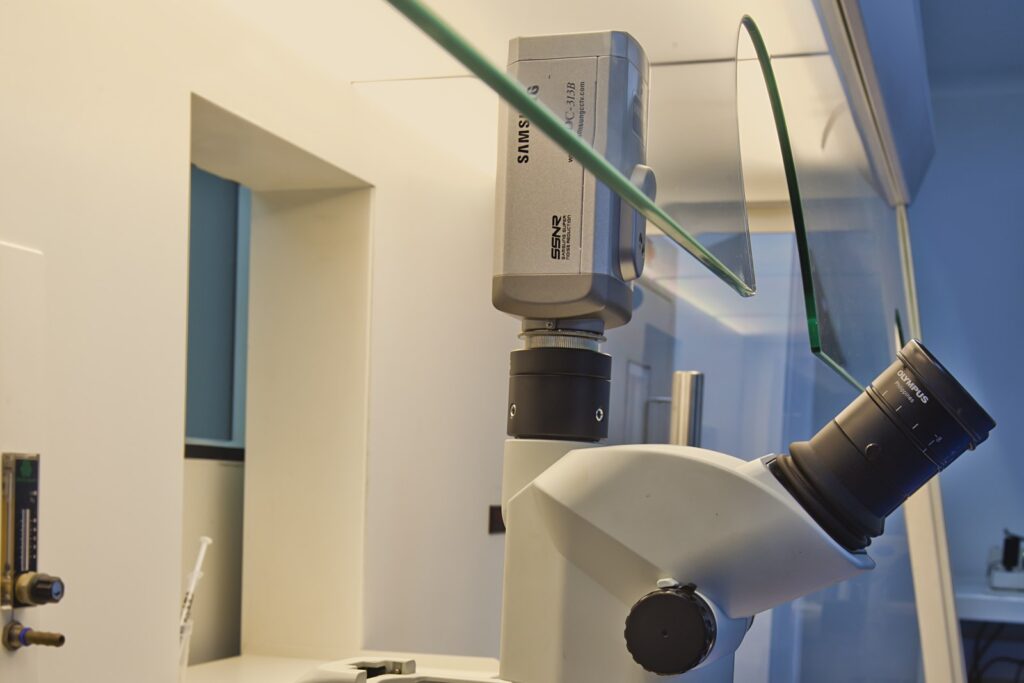
Featured image: “Wings Ivf lab instruments” by Dr. Jayesh Amin, via Wikimedia Commons, licensed CC BY-SA 3.0. Cropped and resized.